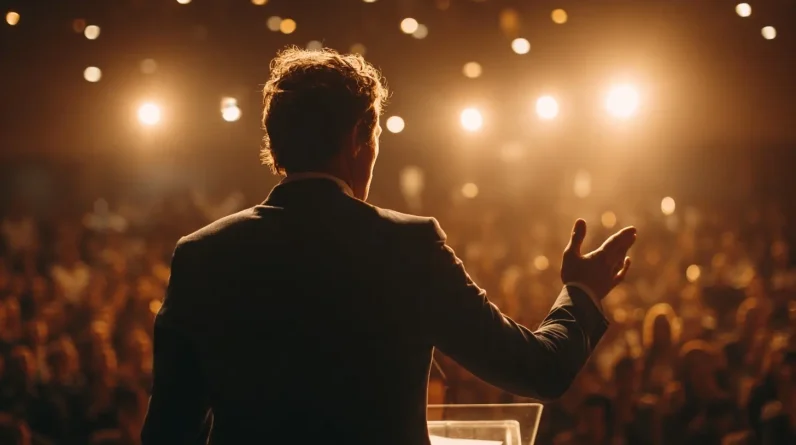
Professional speech creation means treating every word as a deliberate choice, not a placeholder. We lose audiences in the first sixty seconds when our openings drift instead of launch. Filler phrases quietly signal unpreparedness, while weak word choices inform without moving anyone. Every section of a speech must justify its existence, and every detail that doesn’t serve the audience deserves to be cut. Stick with us, and we’ll show you exactly how the best speakers make it happen.
Why Most Speeches Lose the Audience in the First 60 Seconds
Audience engagement isn’t something we earn midway through. We earn it immediately or we lose it entirely. Research confirms that listeners decide within the first sixty seconds whether a speech deserves their focus.
Opening hooks aren’t optional flourishes—they’re structural necessities. A sharp question, a counterintuitive statement, or a precise story fragment can arrest attention before skepticism sets in.
The problem isn’t nerves or inexperience. It’s misplaced priority. Most speakers treat the opening as runway. We treat it as the launch itself. That distinction separates forgettable presentations from ones that move people.
Cut the Filler: What Professional Speech Creation Actually Demands
Filler isn’t neutral—it’s actively destructive. Every “um,” “basically,” and “as I mentioned earlier” erodes credibility and signals unprepared thinking. Professional speech creation demands ruthless editing—stripping filler phrases until only purposeful language remains.
We don’t soften powerful ideas with hedging language. We don’t repeat what we’ve already said. Instead, we replace weak connections with impactful imagery that moves audiences forward emotionally and intellectually.
Ask yourself: does this sentence earn its place? If it doesn’t advance the argument, deepen connection, or reinforce the core message, cut it. Professional speakers treat every word as real estate—valuable, deliberate, and intentional.
The discipline isn’t about saying less. It’s about saying exactly what’s needed—nothing more, nothing less.
How to Choose Words That Work Harder in Every Line
Word choice separates speeches that inform from speeches that move people. We don’t just select words—we deploy them with intention. Impactful vocabulary activates emotion; weak vocabulary dulls even the sharpest argument. Every line demands linguistic precision and clarity focus, ensuring nothing obscures your message.
We recommend building word selection around audience engagement. Ask: does this phrase trigger recognition, tension, or desire? Strategic phrasing leverages rhetorical techniques—anaphora, contrast, active construction—to amplify emotional resonance without inflating word count.
Concrete nouns outperform abstractions. Short verbs hit harder than long ones. When we strip sentences to their strongest elements, every word pulls weight. That’s the standard professional speech creation demands—not eloquence for its own sake, but language engineered to land.
Structure Your Speech So Every Section Earns Its Keep
Structure doesn’t just organize a speech—it determines whether people stay with you or drift. Every section must justify its existence through function, not filler.
We recommend building around three load-bearing elements: a commanding opening that establishes stakes, a middle that advances one central argument, and a close that demands action or reflection.
Audience engagement collapses when sections repeat ideas, stall momentum, or exist simply to pad length. Cut them without hesitation.
Speech clarity emerges when each connection feels inevitable rather than mechanical. Your audience should sense forward motion throughout, never wondering why they’re still listening.
Treat your structure like a blueprint. If a section can’t answer “what does this accomplish?”—it’s dead weight. Remove it, and your speech becomes undeniable.
How the Best Speakers Know What to Leave Out
The instinct to include more—more context, more examples, more qualifications—is what separates average speakers from exceptional ones. Restraint isn’t weakness; it’s discipline.
Every detail you add competes for attention. When everything feels important, nothing is. The best speakers ruthlessly audit their content, asking one question: does this serve the audience or satisfy me?
Message clarity suffers the moment we prioritize thoroughness over impact. Audiences don’t remember everything—they remember what landed. Cutting the third example, the defensive caveat, the background history nobody requested—that’s where audience engagement actually lives.
We protect our speech’s power by protecting its focus. Leave out what’s interesting but unnecessary. Leave out what’s true but tangential. Your audience will lean in precisely because you respected their attention enough to edit.
Frequently Asked Questions
How Long Should a Professionally Crafted Speech Typically Last?
Most professional speeches run 10–20 minutes—the sweet spot for ideal speech duration and audience engagement. We recommend matching length to purpose: shorter for pitches, longer for keynotes. Every second must justify its place.
Should Speeches Be Memorized or Read From Notes?
Like a safety net beneath a tightrope walker, notes benefits keep us grounded. We recommend mastering both—use memorization techniques for key points while referencing notes for precision, ensuring we’re confident and authentic throughout.
How Do You Handle Nervousness Before Delivering an Important Speech?
We combat nervousness with two powerful tools: breathing exercises slow our racing heart, while visualization techniques let us mentally rehearse success. Practice both consistently, and we’ll transform anxiety into focused, commanding energy before every speech.
Can Professional Speech Creation Techniques Apply to Casual Presentations?
Absolutely, we can apply these techniques to casual storytelling too. When we craft purposeful words and prioritize audience engagement, even informal presentations become compelling. We’ll hold attention, spark conversation, and leave lasting impressions every time.
How Often Should You Rehearse a Speech Before the Actual Delivery?
Like sharpening a blade, rehearsal frequency builds speech confidence. We recommend practicing at least five to seven times, ensuring we internalize our message, refine our delivery, and step onto the stage fully prepared.
Conclusion
Research shows the average listener retains only 10% of what they hear—which means we can’t afford to waste a single sentence. Professional speech creation isn’t about saying more; it’s about saying less, better. We’ve covered the cuts, the structure, the word choices that work harder. Now it’s your turn to apply them. Strip your speech down to its sharpest self, and watch your audience finally listen.