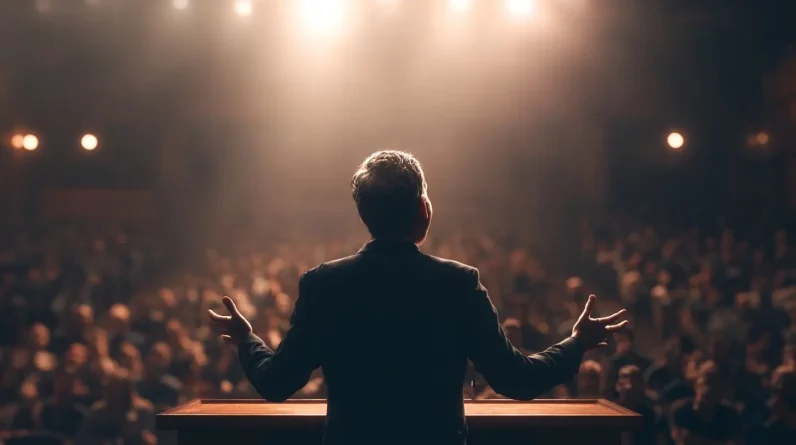
Nailing speech delivery means going beyond memorized scripts and owning every moment on stage. We internalize our ideas instead of reciting words, use vocal pacing and intentional pauses to command attention, and align our body language with our message. Strong eye contact and authentic gestures turn a monologue into a shared experience. When we redirect nervous energy through preparation and visualization, the stage becomes our space — and everything clicks into place from there.
How to Rehearse Your Speech Without Sounding Robotic
Most speakers make one critical mistake when rehearsing: they treat it like memorization rather than internalization. When you obsess over word-for-word recall, you kill natural phrasing and strip away your conversational tone. Instead, rehearse your ideas, not your script.
Here’s how we do it effectively:
- Practice improvisational delivery — speak your core points differently each time to build flexibility.
- Record yourself relentlessly and prioritize feedback incorporation from trusted listeners.
- Focus on emotional engagement — ask what you want your audience to feel, not just hear.
- Pursue authentic expression by rehearsing in varied environments: standing, walking, even whispering.
Mastery isn’t about perfection on script — it’s about owning your message so completely that no setting can shake your delivery.
Vocal Delivery Techniques That Command Attention
Vocal pacing is equally powerful. Rushing signals nervousness; deliberate slowness signals authority. We should practice speaking slower than feels natural, then pause intentionally — pauses aren’t dead air, they’re punctuation. They let ideas land.
Think of your voice as an instrument. Every shift in pace or tone shapes how your audience receives your message. Control these variables, and you stop merely speaking — you start commanding the room.
Body Language and Stage Presence That Wins the Room
Your body speaks before your mouth opens. Master posture control first—stand tall, feet shoulder-width apart, and own your space. Slouching signals doubt; commanding presence signals authority.
Deploy gesture variety deliberately. Purposeful hand movements reinforce key points and sustain audience engagement without distracting from your message.
Eye contact isn’t optional—it’s essential. Scan the room with intention, connecting with individuals rather than staring at a fixed point.
Facial expressions must align with your content. Authentic emotion builds trust instantly.
Use spatial awareness strategically. Move with purpose across the stage; pacing techniques punctuate changes and maintain momentum.
Finally, practice energy modulation. Calibrate your intensity—build toward pivotal moments, then pull back to let your message land. Controlled energy keeps every audience leaning forward.
How to Connect With Your Audience During a Live Presentation
Connecting with a live audience transforms a speech from a monologue into a conversation. Mastering audience engagement means reading the room, responding authentically, and making every person feel seen. Emotional connection isn’t accidental — it’s deliberate.
Use these techniques to forge that connection instantly:
- Make direct eye contact with individuals across different sections, holding each gaze for three to five seconds
- Ask rhetorical or real questions that invite mental participation and signal you value their perspective
- Mirror the room’s energy — if they’re tense, acknowledge it; if they’re energized, amplify it
We don’t just deliver information — we create shared experiences. When our audience feels that we’re speaking with them, not at them, engagement becomes transformation.
Manage Stage Fright Before It Manages You
Even the most seasoned speakers feel their heart race before stepping on stage — and that’s not a weakness, it’s energy waiting to be redirected. We don’t eliminate nerves; we harness them.
Start with breathing techniques: inhale deeply for four counts, hold for four, exhale for eight. This activates your parasympathetic nervous system and signals calm. Do this backstage, not mid-speech.
Next, deploy mental visualization. Before you walk out, close your eyes and see yourself commanding the room — confident posture, steady voice, engaged audience. Your brain processes this rehearsal as real experience, lowering anxiety when the moment arrives.
Preparation is your greatest weapon against fear. When we’ve done the work, the stage becomes familiar territory, not a threat.
Frequently Asked Questions
How Do I Handle Technical Failures Like a Broken Microphone Mid-Speech?
When a microphone fails, we don’t panic—we own it. Explore microphone alternatives like projecting our voice naturally, and use the moment to boost audience engagement by moving closer, making it feel more intimate and powerful.
Should I Memorize My Speech Word-For-Word or Use an Outline?
Like a GPS, outline benefits guide us without locking us in! We recommend mastering memorization techniques for key points, then using an outline to stay flexible—it keeps our delivery natural, confident, and powerfully adaptive.
What Should I Wear to Boost Confidence During a Live Presentation?
We’ll boost your confidence through intentional dress selection—choose attire that fits impeccably and reflects authority. Leverage color psychology by wearing bold blues or reds; they command respect and prime your mindset for powerful, stage-owning delivery.
How Long Before My Speech Should I Arrive at the Venue?
Arrive 60–90 minutes early. We scout the stage, we test the mic, we own the space before anyone arrives. Mastering arrival timing and venue logistics means we eliminate surprises and step up confidently when it’s showtime.
Can I Use Humor Effectively if I Am Not Naturally Funny?
Yes, you can! We don’t need to be naturally funny to use humor techniques effectively. We can craft relatable, well-timed jokes that boost audience engagement. Practice delivers confidence, and confidence makes even simple humor land powerfully.
Conclusion
We’ve covered everything you need to transform your speech from words on a page into a powerful, memorable performance. Like an athlete who trains before the big game, consistent practice and intentional preparation separate forgettable speakers from unforgettable ones. Now it’s time to step away from the script, own the stage, and trust your preparation. Your audience isn’t waiting for perfection — they’re waiting for you.